The Atlantic's Faltering Heartbeat: What is AMOC?
Scientists warn a critical Atlantic Ocean current system, AMOC, is weakening. Discover what this 'climate engine' is and why its potential collapse matters to us all.
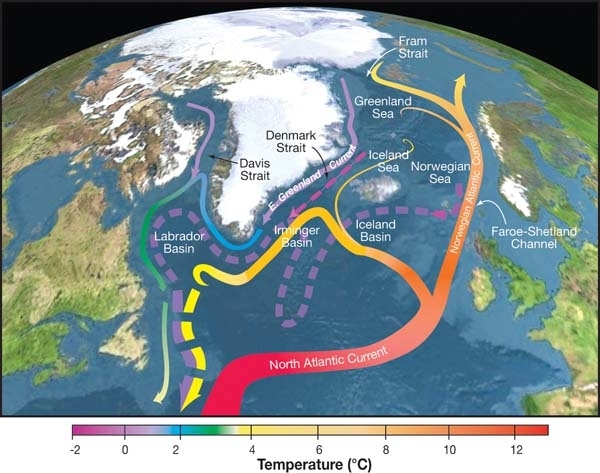
The Planet's Ticking Climate Clock: What is AMOC and Why Should You Care?
Imagine the Earth has a circulatory system—a vast, powerful network of currents that transports life-sustaining warmth around the globe. Now, imagine scientists are warning that this system is showing signs of slowing down, potentially heading towards a collapse.
This isn't the plot of a disaster movie; it's the reality of the Atlantic Meridional Overturning Circulation (AMOC). For professionals in sustainability, innovation, or any forward-thinking industry, understanding AMOC isn't just an academic exercise. It's about recognizing a systemic risk with the potential to reshape our world, our economies, and our future.
Let's break down what AMOC is, why it's in trouble, and what that means for all of us.
What is AMOC? The Global Climate Engine
Think of AMOC as a massive global conveyor belt in the Atlantic Ocean. Here’s how it works in simple terms:
- Warm Water Travels North: The process starts in the tropics, where the sun heats surface water. Currents, including the well-known Gulf Stream, carry this warm, salty water north towards the pole.
- Heat is Released: As this water travels, it releases enormous amounts of heat into the atmosphere, which is a key reason why Northern Europe (think the UK and Scandinavia) has a much milder climate than other regions at the same latitude (like parts of Canada).
- Cooling and Sinking: As the water reaches the North Atlantic near Greenland, it cools down. The combination of cooling and high salt content makes the water denser, causing it to sink deep into the ocean.
- Cold Water Returns South: This cold, deep water then flows back south, continuing the cycle.
This constant circulation is a fundamental driver of global climate patterns. It influences everything from European weather and sea levels on the U.S. East Coast to the strength of monsoon seasons in Africa and Asia.
The Warning Signs: Why Is the Conveyor Belt Breaking?
The primary culprit behind the weakening of AMOC is climate change. The mechanism is straightforward but alarming.
The massive ice sheet covering Greenland is melting at an unprecedented rate. This isn't just adding water to the ocean; it's adding a huge volume of cold, fresh water.
Remember how AMOC's engine is driven by salty water becoming cold and dense enough to sink? Freshwater is less dense than saltwater. When this fresh meltwater pours into the North Atlantic, it dilutes the salty surface water, making it lighter and less able to sink.
Essentially, we are watering down the engine of this critical current system, putting the brakes on the entire conveyor belt. Recent studies, including a notable one from the University of Copenhagen, suggest we may be approaching a tipping point much faster than previous models indicated, with a potential collapse possible within this century.
The Ripple Effect: Who Will Be Affected?
A slowdown or collapse of AMOC would not be a localized event. The consequences would be global, severe, and disruptive, affecting billions of people and countless industries.
- Northern Europe: Would face the most dramatic effects, with temperatures potentially dropping by 5-10°C (9-18°F). This would lead to much harsher winters, disrupting agriculture, energy consumption, and infrastructure.
- North America: The U.S. East Coast could experience accelerated sea-level rise as the dynamics of the Gulf Stream change.
- The Tropics: Critical rainfall patterns, including the monsoons that billions of people in Africa, India, and South America depend on for agriculture and drinking water, could be radically shifted or weakened.
- Global Ecosystems: Marine ecosystems would be thrown into chaos, threatening fish stocks that are a primary food source for millions. The disruption to weather patterns would impact food security worldwide.
For professionals, this translates into unprecedented supply chain disruptions, resource scarcity, and economic instability. It's a stark reminder that our global economy is built on a foundation of climate stability—a foundation that is now cracking.
Conclusion: From Awareness to Action
The weakening of AMOC is one of the most serious 'tipping point' scenarios climate scientists have identified. It's not a distant, abstract threat but a clear and present danger tied directly to the warming of our planet.
Key Takeaways:
- AMOC is a vital climate regulator: It's a massive ocean current system that distributes heat and influences weather worldwide.
- It's weakening due to climate change: Melting ice from Greenland is disrupting the delicate balance of salt and temperature that drives the current.
- The consequences are global: A collapse would trigger dramatic cooling in Europe, shift rainfall patterns in the tropics, and disrupt ecosystems and economies globally.
This isn't a call for despair but for urgency. The science is a warning, not a prophecy. The challenge of stabilizing AMOC is directly linked to the challenge of decarbonizing our world. It underscores the critical need for innovation in renewable energy, sustainable agriculture, and circular economies.
As leaders, innovators, and professionals, the question we must ask is no longer if we should act, but how we can accelerate the transition to a sustainable future. What role will you play in strengthening our planet's resilience?
image credits: By R. Curry, Woods Hole Oceanographic Institution/Science/USGCRP. - http://editors.eol.org/eoearth/wiki/File:OCP07_Fig-6.jpg, CC BY 3.0, https://commons.wikimedia.org/w/index.php?curid=61272315
Loading comments...